I. Industry Insight: Airtightness Bottlenecks in Precision Die Castings
In modern precision manufacturing sectors such as automotive production, hydraulic machinery, marine engineering, and military industries, non-ferrous metal die castings like aluminum, zinc, magnesium, and copper alloys are widely utilized. However, due to volumetric shrinkage during the solidification of molten metal, internal defects like micropores, pinholes, and porosity are inevitably formed within the castings. These minute defects can easily interconnect after machining operations, leading to micro-leakage when the casting is subjected to gas or liquid pressure.
Traditional external coatings fail to fundamentally eliminate interconnected internal micropores, which severely compromises the airtightness, physical strength, and subsequent electroplating or finishing quality of the products. Vacuum Pressure Impregnation is globally recognized as the most efficient and reliable method for leak repair and micropore sealing in castings. It utilizes a vacuum-pressure sequence to force an impregnating agent deep into internal defects, which then cures to fill the micropores and achieve a durable pressure-resistant seal.
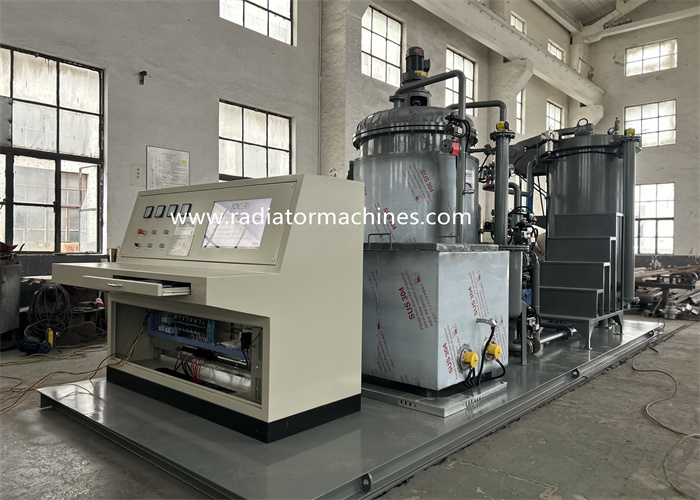
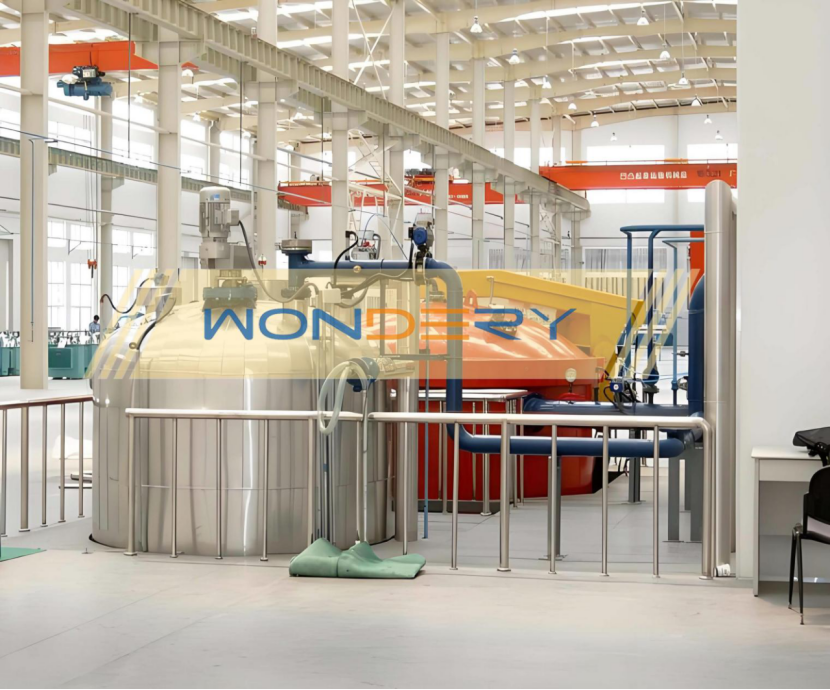
Following its advanced achievements in large-scale continuous fluid heating furnace lines (Model: WDL260608BR), WONDERY has once again asserted its core competency in fluid pressure control and micro-cavity sealing technology. Referencing the technical standards in "1350 Semi auto vacuum impregnation equipment.docx", WONDERY delivered the JS1350 Intelligent Fully Automatic Vacuum Pressure Impregnation System (Technical Proposal: WDL260608CA). This international delivery was conducted and successfully commissioned for BSB Manufacturing under the direct supervision of their Chief Professional Engineer, Narinder (Nindi) Bhogal P.Eng.
II. Technical Solutions and Process Architecture
1. Detailed Description of Core Process Units
Vacuum Impregnation Unit: The impregnation tank features an internal diameter of $Phi1350 text{ mm}$ and is fabricated from premium SUS304 stainless steel plate (6-8mm shell, 1.0mm cladding) with a one-piece forged flange and a quick-acting pneumatic lid mechanism. Powered by a high-efficiency vacuum pump and a dedicated refrigeration unit, the operating negative pressure is maintained between $-0.098 text{ MPa}$ and $-0.100 text{ MPa}$. Utilizing dry and wet vacuum cycles, the sealant is forced deep into the micropores. The tank is wrapped with a $40text{ mm}$ thick insulation layer integrated with a cooling jacket to maintain the organic sealant temperature at a constant $0 sim 28^{circ}text{C}$, ensuring optimal chemical viscosity and stability.
6-Direction Centrifugal Sealant Recovery Unit: Complex die-casting geometries often retain excess sealant within blind holes and threaded cavities after immersion. WONDERY addresses this via a two-step centrifugal dehydration design. Once the material basket is loaded via the crane, a worm gear reducer drives a high-speed forward and reverse rotation at $0 sim 100 text{ r/min}$ (VFD adjustable) to dehydrate four machined surfaces. The mechanism then automatically tilts $90^{circ}$ to centrifugally spin the remaining two surfaces. This 6-directional action reduces sealant consumption by one-third, and the recovered agent is pumped 100% back to the main tank for recycling.
3-Stage Tilting High-Pressure Rinsing Unit: Conventional immersion washing methods tend to cause secondary water contamination. This rinsing system utilizes a Bonfiglioli reducer to rotate the material basket while a high-pressure pump sprays clean water through structured nozzles onto the moving workpieces. Paired with a 3-stage tilting countercurrent drainage mechanism, it cuts industrial water consumption by nearly half and completely eliminates sealant clogging in threaded and blind holes, removing the need for manual air-blowing operations.
Rotating Hot Water Curing Unit: The thoroughly washed workpieces move to the hot water curing tank, where high-power stainless steel heating elements automatically regulate water temperatures to $90 sim 93^{circ}text{C}$. The components undergo a 10-15 minute clockwise and counter-clockwise thermal curing cycle. During the water discharge phase, the tilting system rotates at full speed to empty accumulated water from blind holes, achieving a rapid drying effect via residual heat, while a steam extraction fan sweeps away excess workshop vapors.
2. Intelligent Electrical Control Cabinet & Integrated Safety System
Core Hardware Architecture: Automated logic throughout the line is orchestrated by a Japan-imported Mitsubishi PLC and its expansion modules, paired with a premium 14-inch MCGS digital touchscreen HMI and CHINT low-voltage electrical switchgear.
One-Click Automated Operation: The continuous line supports "One-click start" functionality. The full impregnation cycle—encompassing tank loading, vacuum extraction, automated descent immersion, 6-directional spinning, spraying, and hot water curing—is locked into a precise 15 minutes per basket sequence.
High Protection Ratings & Isolation Safety: The operator control panel and body-mounted electrical components feature an IP55/IP66 protection rating, ensuring high resistance against dust, moisture, and chemical sealant corrosion. The system integrates a standalone stainless steel vacuum isolation tank fitted with drying filters and a large-diameter pressure relief valve, preventing trace liquids or moisture from entering the vacuum pump. Furthermore, the control architecture includes a pre-wired communication interface for future robotic arm integration.
III. Core Consumables: Third-Generation 902 Organic Sealant Characteristics
Along with the hardware installation, WONDERY supplied 2,000 kg of its flagship consumable—WONDERY 902 High-Performance Organic Impregnation Sealant. Formulated specifically for micro-porosity in non-ferrous castings, it delivers an impregnation qualification rate exceeding 99% for micropores under $0.1text{ mm}$:
Physical & Chemical Profile: A two-part water-soluble resin comprising a main agent (methacrylic acid monopolymer) and a hardener, yielding a low blended viscosity of 9 mPa·s. Any remaining surface residue can be washed away easily with water without organic solvents. Its high boiling point under vacuum minimizes vapor generation, preventing excessive operational loads on the vacuum pump.
Harsh Environment Durability Certifications:
Thermal & Fluid Resistance: Retains complete pressure-tight sealing integrity after continuous exposure to $200^{circ}text{C}$ dry heat for 50 hours, as well as immersion in engine oil/lubricants at $120^{circ}text{C}$ for 50 hours.
Chemical Medium Endurance: Demonstrates complete chemical inertness with zero degradation when exposed to long-life coolant (LLC at $100^{circ}text{C} times 10text{ h}$), aviation kerosene/diesel (7 days at room temperature), and refrigerants like Freon R22/R134A (7 days).
International Standards Compliance: Successfully passes all stringent testing protocols under the MIL-I-6869D military standard, including sandblasting resistance, grease washing stability, and paint finish compatibility.
IV. Verified Production Capacity and Commercial Framework
Capacity Calculation: Designed for die-cast parts measuring $L470 times W370 times H216 text{ mm}$, each material basket accommodates 16 pieces. Under a standard 10-hour single-shift operation (32 baskets/day), the line yields 512 parts daily, totaling 10,240 qualified parts per month (20 days). Under a high-load 20-hour double-shift schedule (70 baskets/day), it reaches a high throughput of 1,120 parts daily, or 22,400 parts per month.
Commercial Parameters: The turnkey system carries a total EXW valuation of $151,000.00 USD (inclusive of the JS1350 hardware plant and 2,000 kg of 902 sealant). WONDERY provided free spare parts, including a replacement Y-seal ring and two 12kW corrosion-resistant electrical heating elements, completing modular disassembly and containerized ocean shipping within 70 working days from down payment receipt.